Resisting AI and Technology for the Analog World, Starman After Midnight Award Finalist, Upcoming Events, and More
Subscribe to get the newsletter in your email inbox. Never miss an update. Subscribe today!
Welcome to the March 2026 edition of my newsletter. Sorry I’ve been silent recently in the newsletter department. The last few months have been rather trying as my favorite uncle passed away in November and the mother of one of my best friends also passed away in December, putting a damper on the holidays. The first two months of the new year I was busy writing new fiction and finishing up a new novel manuscript—a comedy! I’m very excited about this new novel. We’ll see if I can find a new publisher for it this year.
I took my family to see the new movie Good Luck, Have Fun, Don’t Die a couple of weeks ago. It’s a fun sci-fi comedy like a cross between The Matrix and Groundhog Day. Although a little heavy-handed in some spots, it’s a fun flick. And my wife and I found ourselves liking the movie more as the days went by, discussing some of the scenes we couldn’t shake from our minds. The movie is about a time traveler who comes back to the present to recruit a crew of do-gooders to fight an impending AI apocalypse. We marveled at how the movie depicted people’s addiction to social media as making them something akin to zombies. It was almost unbelievable really, until I noticed a few days later, people in a bistro silently gazing at their phones, ignoring their companions at the table. Maybe this movie is more prescient than we initially thought, this scene in real life playing out like it was from this movie. Crazy!
There is real evidence that people are rejecting AI technology and social media specifically. Kids are turning their backs to social media by using flip phones, which they can’t install apps on, and actually going outside to hang out with their friends. This may seem unbelievable to you, but it’s a real-world phenomenon. Young people are understanding more and more what social media has done to them and their friends, and they are wholeheartedly rejecting it in some cases. There’s hope for these younger generations, it seems.
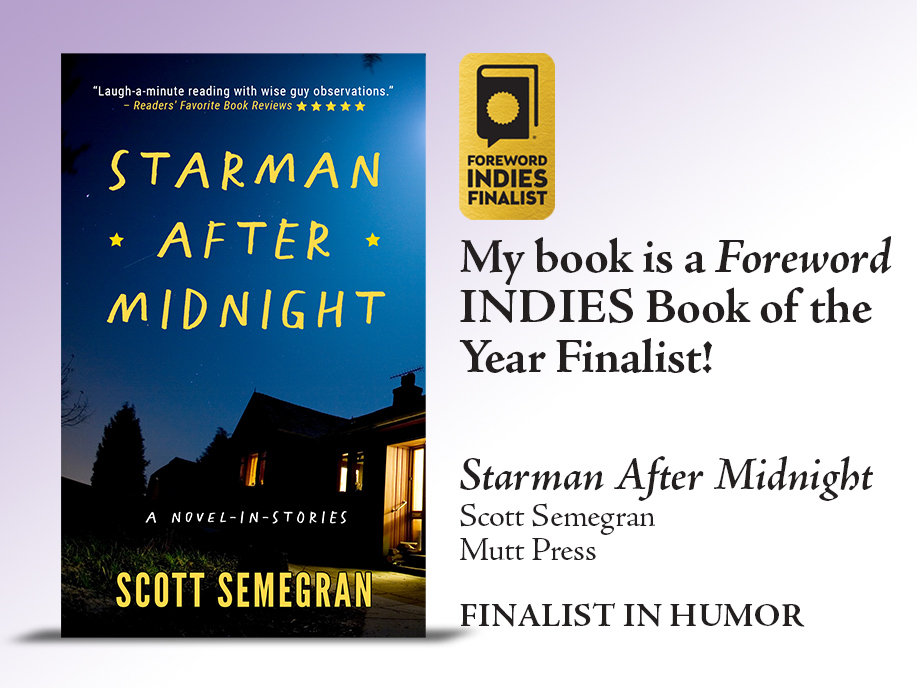
Starman After Midnight is a Foreword INDIES Book of the Year Finalist for Humor. Winners will be announced in June 2026. It's always an honor to be selected as a finalist for a book award especially one like this that celebrates independent publishing of the highest caliber. Thank you to the editors of Foreword Reviews for this honor. And congratulations to all of the finalists this year.
I'm pleased to announce my appearance on the Desideratum Podcast along with the narrator from my audiobook Starman After Midnight, Brian P. Craig. Hosted by Emmy Award-winning narrator Theresa Bakken, Brian and I discuss with Theresa how we created the audiobook as well as my thoughts into the creation of my story. I really hope you enjoy listening to our conversation! Please support the Desideratum Podcast by purchasing my audiobook through their affiliate link to Libro.FM, the audiobook retailer that supports indie bookstores.
Listen Now:
If you enjoy listening to podcasts in your preferred audio servce, then here are links to several:
I've been writing fiction and publishing books in Austin, Texas for 30 years, but it's a real trip seeing my face and reading about my creative work in the Austin Chronicle for the very first time! Thank you Oscar Rodriguez and the Austin Chronicle for featuring the audiobook for my novel-in-stories STARMAN AFTER MIDNIGHT!
On Saturday, July 12th, I drove from Austin to Wimberley, Texas to spend time at Fair Dinkum Coffee Shop with award-winning author James Wade, and to talk about writing and books and his latest novel Narrow the Road, an excellent work of historical fiction that—in my estimation—is somewhere between Huckleberry Finn and The Body by Stephen King. It’s also, I believe, his best novel yet. At this point in time and history around our interview, Texas had just experienced its worst flooding in a while. Initially, we glumly talked about the victims from Camp Mystic in Kerr County and the poor response from political leaders in Texas, but that wasn’t our focus for this interview. We were there in that quaint coffee shop to talk about Narrow the Road, and so much more. Here’s where we started.
***
Scott Semegran: Let’s talk about your new book, the new novel Narrow the Road. It’s your fifth novel in six years. You’re quite the prolific writer. It’s such a fantastic book. You received your first Publishers Weekly starred review. What was the initial nugget of inspiration for you and this story?
James Wade: I had spent a good deal of time researching East Texas around the Great Depression era for my last novel, Hollow Out the Dark, and even after I’d written the book it still felt like there was more to tell about this time period and this place. So I had my setting, but I wasn’t sure what the story would be. I decided to start in a town I’d always wanted to write about—Manning, Texas. It was a mill town. Now, it’s nothing more than basically a historical marker, but Manning was a thriving mill town in the early 1900s, and my great-grandmother was born there, and so I had always heard of Manning growing up, and how it was purely a company town. That means the company built your house. They stocked the store and the commissary where you spent your wages. There were movie theaters that the company would pay for movies to come in and for performers. So it was really the most labor-focused community. Also, it was segregated. They had whites in one area Blacks in the other. They also had Italians in one area, which I didn’t know there were a ton of Italians in East Texas in the 1920s. So, I was fascinated by Manning and the way that the town worked, the way they got supplies there on the rail and brought in things like great blocks of ice that took several people to unload off the train. So I had all this interest and background with Manning, and then when I sat down to write, I realized it was going to be a story about this boy’s journey, in both the physical and spiritual sense. So alas, we had to leave Manning pretty early on.
As both a reader and a writer, I love stories where you have a point A and a point B, and then you just go along the path to something. It’s a lovely metaphor for grander themes, but on a more practical level it kind of keeps the momentum going for the writer. It takes a little bit of the pressure off. You already have some built-in motion happening.
SS: I’ve read all of your novels and I noticed something starkly different with this one. So, unlike your other novels, which have these unrelenting forces coming in from the outside causing the protagonist to do something in particular, whether it’s people from the outside, coming in doing things to them, someone dies, or someone’s making decisions for them. In this novel, that inciting force is coming from within a family and, particularly, the repercussions from William’s father’s decisions. So, can you talk about this change in focus? Because for me, at least having read four of your books before, it was rather a stark difference, and I really became fascinated with the story earlier on because of that difference. Can we talk about that?
JW: With this novel and for this character, William Carter, his circumstances are still dictated by outside forces. He’s in the position he’s in based on a number of things: the Great Depression, failing cotton farm, his mother’s illness and her refusal to be treated by doctors, the choices that his father has made. All of this is outside of his control, certainly. But to your point, every action in the book happens because William makes a decision. First one, then another, and we see him take agency of not just his life but of the plot, and that is very much on purpose to where, from the moment that he makes the decision to leave to the moment that the book ends, he is the one who was in control of the story. And that is part of the hero’s journey, and it puts him in that light, and it lets the reader be close to him. We see how he agonizes over some of these decisions.
THE CODGER AND THE SPARROW is the Discovery Prize Winner for Fiction in the 2024 Writers' League of Texas Book Awards. According to the Writers’ League of Texas, “the WLT introduced the Discovery Prize to recognize one outstanding book in each category published by independent presses, university presses, and/or self-published authors… for its fresh voice, inventive story, or some other element that made it stand out.” Because of this, I’m honored that they selected my novel as the Discovery Prize Winner for Fiction. Thank you to the judges of this prize and to the Writers’ League of Texas!





 Starman After Midnight


